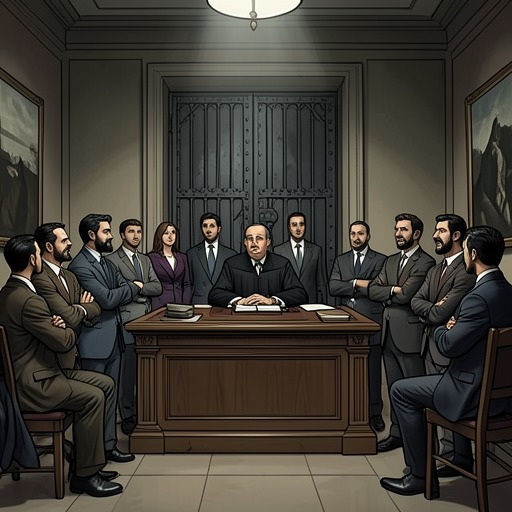
Everybody lies: trial as a contest of lies
The Brass VerdictEverybody lies: trial as a contest of lies is Michael Haller’s description of the courtroom as a contest in which advocates must identify and use the lie that can open a case to scrutiny. Its central image is a blade forged from a witness’s falsehood: not a license to invent a defense, but a method of finding a weakness in the prosecution’s account and testing what its evidence can actually establish.
The courtroom as a contest of accounts
Haller begins from the premise that deception is expected throughout a trial. Police officers, lawyers, witnesses, victims, judges, and jurors all enter a setting where statements may be untrue or misleading. The jury, in particular, knows that it will hear lies; the defense lawyer’s task is therefore not simply to announce that someone has lied, but to recognize which lie matters and patiently draw it into view.
The governing metaphor gives that work a physical shape. Haller describes waiting for a lie he can seize, forge, and sharpen into a blade, then use to cut open the case. The sequence matters: patience comes before confrontation, and a witness’s account becomes useful through examination rather than accusation alone. Haller casts the defense lawyer as an instrument for testing the state’s case, even when the client’s own conduct makes that role personally uncomfortable.
From witness detail to a usable weakness
The image emerges during the trial of Barnett Woodson, who faced two murder charges. Haller believes Woodson killed the two victims, but treats his own task as testing the prosecution’s case by the strongest means available. That distinction gives the metaphor its procedural force: a defense can challenge the state’s proof without requiring the lawyer to believe the client innocent.
When prosecution witness Torrance describes a supposed confession, Haller presses him to give the account in fuller form. Torrance’s extended answer supplies details about the alleged conversation and the victims, while Jerry Vincent, the prosecutor, objects that Haller is badgering the witness. Haller maintains that testimony placing a confession in his client’s mouth warrants examination of its content and context. He notices Vincent flinch during the answer and takes the reaction as a sign that the testimony has exposed something worth pursuing. The passage turns the general principle into courtroom practice: the aim is to let a witness’s own elaboration make the potential weakness visible.
Haller’s account of the examination also distinguishes the concise quality of truth from the length and padding that can surround a lie. He compares jailhouse informants with confidence tricksters, who use misdirection and banter to hide what they are doing. On this view, extended testimony is not automatically more persuasive. Its extra detail gives the examiner more material to test, and seemingly incidental language or context may help disclose the larger falsehood.
The consequences do not erase the difference between winning a legal advantage and establishing innocence. After Woodson’s immediate situation improves, Haller makes clear that he has no expectation that his client will simply walk away from the deaths. The blade has done its work against the state’s case, but it has not transformed Haller’s private assessment of Woodson or made the victims’ deaths disappear. The contrast defines the reach, and the limit, of adversarial advocacy.
Competing stories and the meaning of evidence
The same method shapes Haller’s defense of Walter Elliot. Haller identifies the prosecution’s proposed motive and opportunity: Elliot’s wife had an affair, a prenuptial agreement had vested, and investigators argued that the timing of his car’s departure from Archway made it possible for him to reach the Malibu house during the killings. Yet Haller describes the remaining evidence as thin and circumstantial. His task is to make the jury distinguish a coherent accusation from proof sufficient to establish guilt.
In his opening statement, Haller presents the prosecution’s elaborate account as smoke and mirrors and promises that examination of the evidence will reveal no case against Elliot. This is advocacy shaped as a counter-story: rather than merely answer each accusation separately, he offers the jury an organizing interpretation in which apparent support for the prosecution dissolves under scrutiny. The metaphor of the blade and the metaphor of smoke perform related work. One names the method of exposing a weakness; the other names the impression that the defense seeks to dispel.
The gunshot-residue evidence provides a concrete example of why a test result and the story attached to it are not the same thing. Search warrants authorized tests of Elliot’s hands and clothing, and chemically treated disks wiped on his hands and sleeves returned positive results for elevated residue. At trial, defense expert Shamiram Arslanian agreed that the tests detected elements associated with gunshot residue. Her disagreement concerned what that detection meant: she assessed transfer as highly likely, rather than concluding that the residue showed Elliot had fired a gun.
Arslanian traced the proposed transfer to Elliot’s placement, handcuffed, in the back of the 4-alpha patrol car. She described residue from another case in the car as the initial source, then explained that contact and ordinary movement could transfer material from Elliot’s hands and arms to the front of his jacket. The pattern was thus presented not as a single, self-explanatory result, but as a chain of exposure and transfer. The distinction exemplifies Haller’s broader approach: evidence can be genuine while the inference drawn from it remains contestable.
Strategy, silence, and professional limits
Haller’s account also makes clear that interpretation does not remove the lawyer’s ethical obligations. Elliot’s case contains a hidden jury-manipulation plan: Elliot tells Haller that Jerry Vincent had said the planned fix was unnecessary because he had the magic bullet and expected to win without a sleeper on the jury. Haller reasons that Vincent’s decision to delay the trial, after that assurance, may explain why Vincent was killed. The disclosures give Haller a new account of the case, but they also place confidential information in his hands.
Haller distinguishes Elliot’s admissions about crimes already committed from the planned jury tampering, which had not yet occurred. He recognizes that the future crime raises a different question from information protected by the attorney-client relationship and considers whether he can prevent it from happening. The contest of lies therefore has a limit that the blade metaphor alone cannot settle: a lawyer must assess not only how information can undermine a case, but also what professional duties govern its use and disclosure.
The idea also resonates with Haller’s advice that Elliot should have stopped speaking to investigators earlier. Elliot initially gave an account, then chose to stop answering questions and ask for an attorney after being advised of his rights. Haller frames that decision as belated but preferable to continuing to talk. In this strand, the defense lawyer’s work is not to produce a more convincing story at any cost; it includes protecting the client from supplying statements that investigators may use against him.
Across the Woodson and Elliot cases, the concept joins skepticism to discipline. Haller does not treat every assertion as equally important, nor does he assume that a positive test or a confident witness settles what happened. He waits, tests context, separates observation from inference, and attends to the chain that connects evidence to accusation. The trial remains a contest of accounts, but the defense’s strongest instrument is not simply a counterclaim: it is a specific, examinable weakness that can make the jury reconsider how the state’s story was built.